Showing posts with label Salem Alleys. Show all posts

Thursday, February 7, 2013

Downtown Alley, Episode 2


Last fall I took a slow saunter via bike through one of the alleys downtown here in Salem. I was familiar enough with this alley to know it was of interest, as at some time in the past (I think the early 80’s or so) it received a fairly careful makeover. It serves as an example of the creativity of a particular era of urban planning, one that was occasionally quite lovely and hopeful—especially after the concrete brutalism of the 60’s and 70’s still scarring parts of this city. Some months ago I posted a photo essay of this alley’s first block (south-to-north); this second installment looks at photos of the succeeding block that warm afternoon.

 The alley in question (between Liberty and Commercial Streets) serves a wide variety of businesses, offices, and residences. This section begins with State Street, one of the broad, nineteenth century thoroughfares found in Salem’s historic downtown core.


The entrance is framed by a fine Victorian shop-front and a tiled, decorative office building façade (the office of one of Salem’s best known architects, responsible for rather a lot of clearly-identifiable edifices in this burgh). A wide brick expanse greets anyone entering this alley, as does one of the signature elements of this (and the next) block: Japanese Wisteria.


This botanical Triumphal Arch creates a deep bank of foliage that is home to many critters. It softens and cools the entrance to the alley in the summer, perfumes it with thick cascades of flowers in the spring, paints it in warm yellow in fall, and wreathes it in wisps of branch and vine in the winter.

Past the wisteria-arch, we enter into the workaday world of an urban alley: back entrances to businesses, garbage dumpsters, gas and electric meters, and the outdoor storage for what cannot be fit anywhere else.
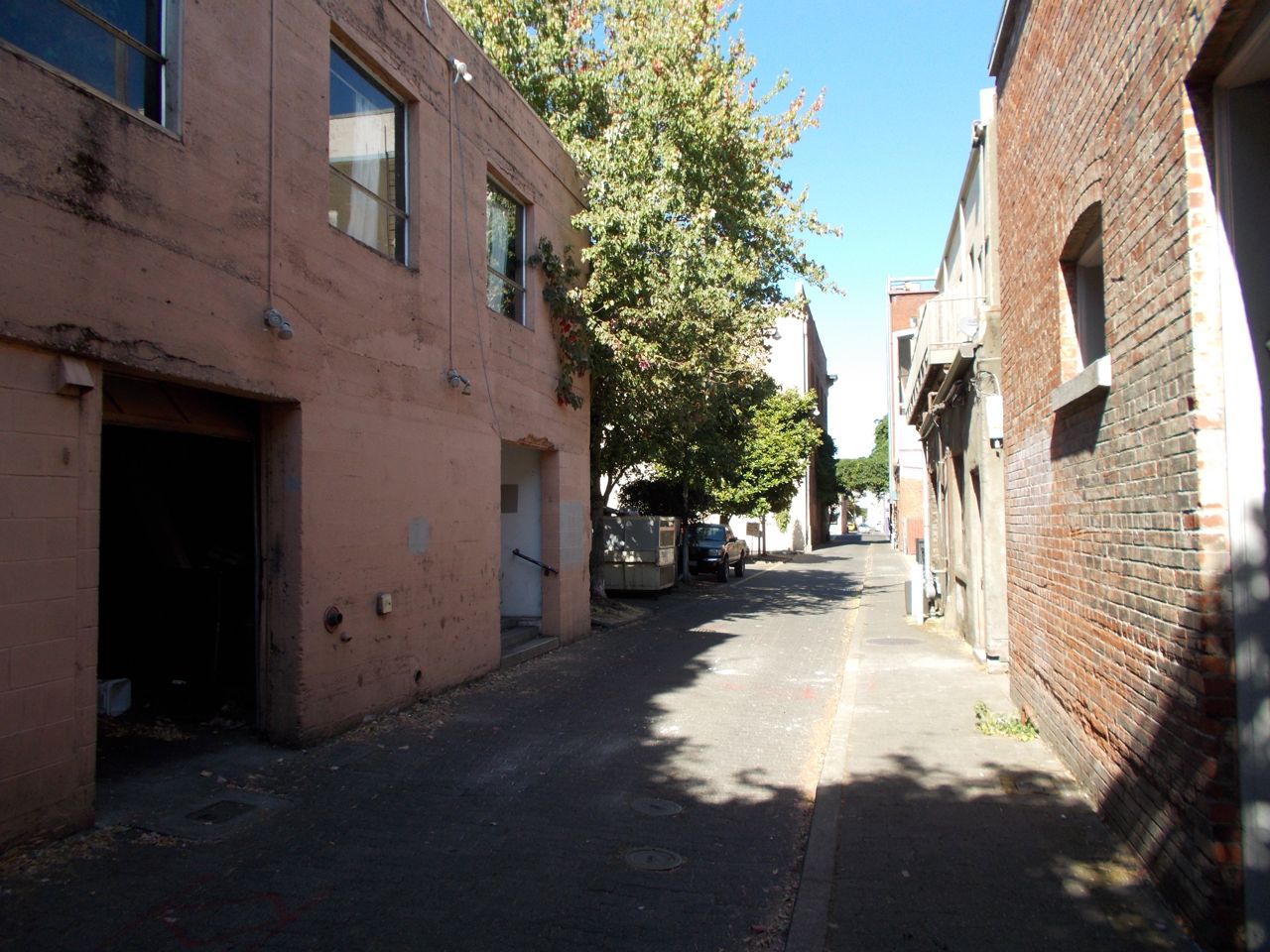
 One building has a stucco wall that, perhaps due to the intrusion of moisture, perhaps mirroring the topography of what is underneath, undulates with a wild, Gaudi-esque vibe. Hidden, tired, and rather dusty, its biomorphic waves always charm me when the light hits it at the right angle.


Strewn along the way underfoot one finds a collection of interesting manhole covers:

Here is an old Bell System access point. It presents the viewer with a magnificently detailed geometric pattern, arresting in its control and execution. All that for a non-slip surface!

 This detail of the cover's center reminds me it wasn’t all that long ago that there was only one “Phone Company” in every town, and that the Bell System trademark was ubiquitous. It meant “telephone.” It all seems closer to Alexander Graham than it does to Steve Jobs now—though it really isn’t.

 Another manhole cover presents concentric circles, emblazoned with the manufacturer’s name and the City of Salem’s ownership, indicating that it provides access to city services, I suppose.

Another cover shows a grid-like pattern, filled here with the crumbled detritus of dried autumn leaves. It proudly announces its provenance, as well. Such care taken with utterly utilitarian things!

Looking up now, one spots a rooster. Yes, that’s right—a rooster. It is ceramic, but a rooster nonetheless, perched on the balcony of a newly-renovated downtown apartment building. I look forward to this whimsical accent whenever I pass through. I very much like the way residences are finding their place back downtown.

Next door to the “roosterage” is the back of another commercial/apartment building. It, too, has been nicely restored, presenting a large expanse of clean, re-pointed bricklaying. It makes one think about what it must be like to live in the middle of so much activity and noise. The brick walls must help.

A yoga studio inhabits part of the first floor of this building, and apparently one enters by the alley—one of a number of such public connections between the main streets and the alley. A very fancy chromed bike rack has been placed by the entrance, complete with an artistic (though now rather altered) welded-chain sign reading “Yoga,” making one a bit concerned about parking her for any other purpose.

Further on one reaches an expanse of wall largely covered in gas pipes, electrical conduit, and ventilation piping. With shadows cast by the afternoon sun, it takes on a downscale chiaroscuro I find rather pleasing.

The ventilation pipes (stovepipes?) here are really quite something. They have to travel up a long distance to discharge whatever it is they carry, creating an effect reminiscent (to me) of the precisionist paintings of someone like Sheeler. I find this particular view rather mesmerizing.

This block of the alley ends with a spectacular display of wisteria again, creating another triumphal arch leading us into Court Street. When I pass through this I am always taken back briefly to a visit I made to Paris when in my teens. I remember slipping from a busy street into the courtyard of a sumptuous art nouveau apartment complex via a short alley hung with similar vines. That is a nice memory to have, even if this isn’t Paris, and there isn’t a trickling fountain in an octagonal courtyard anywhere nearby.

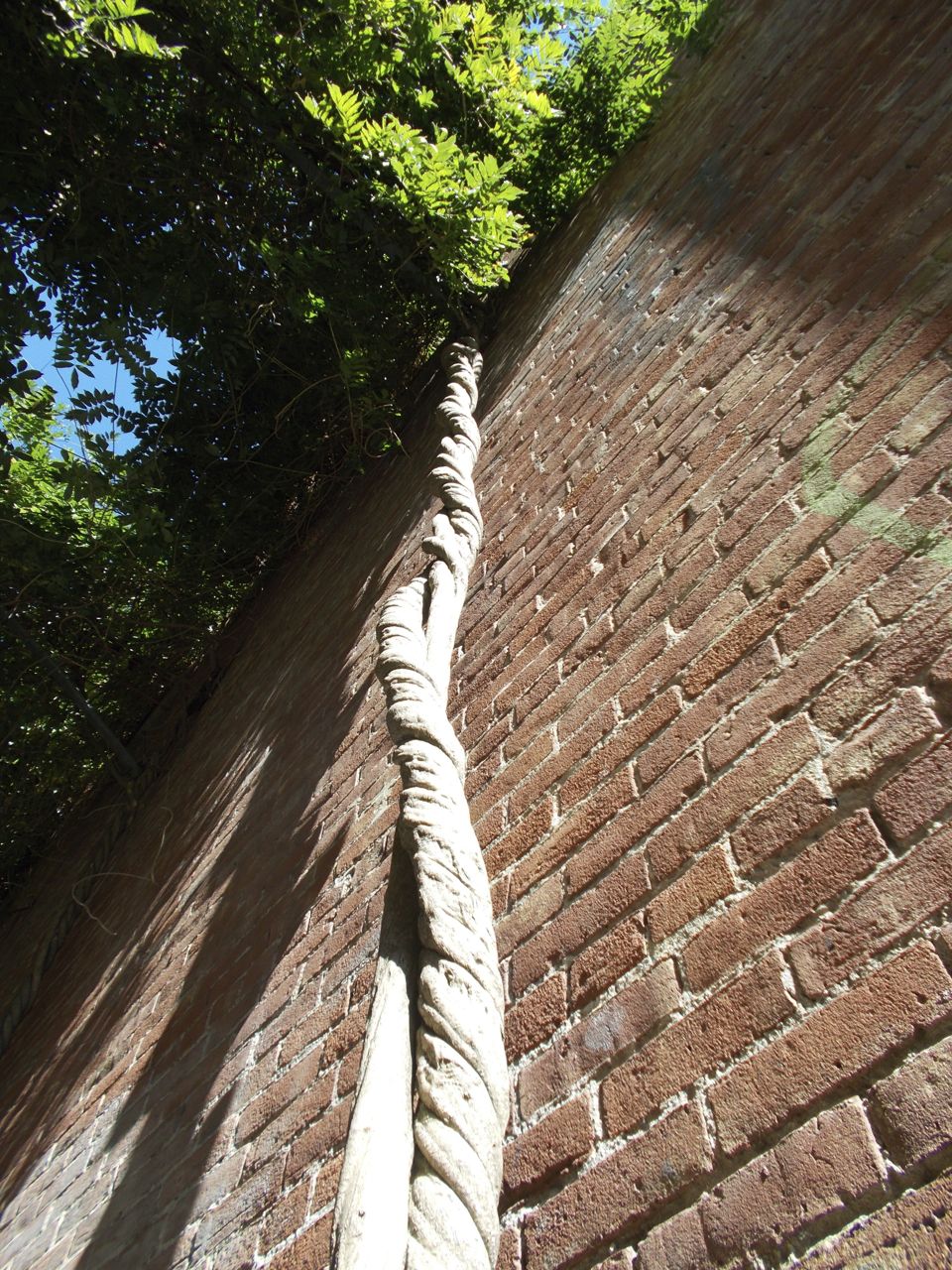
Wisteria is a tenacious plant, and its vines convey that. Here one climes a pole to reach its destination (can wisteria ever be said to have reached its destination, I wonder?). In so doing, it forms Bernini-like columns of life-conveying fiber— perhaps Bernini got the idea from such plants?
The last stop on this block is the entrance to Court Street, where the alley’s asphalt reaches the pavers marking a crosswalk (not a cross-drive, as the sign to the right makes clear); the awnings of the Reed Opera House stretch out to meet the street and the alley emerges once more into the world it serves.

While this block doesn’t have much public art (as did the last one), or a heavily-developed “theme,” its unity is provided by the wisteria, where on a warm day the pigeons gather to be fed by passers-by in its cooling shadows. That's enough of a theme for the birds...and for me. 

Enjoy the hidden blessings of life!


Wednesday, January 30, 2013

Summer will come again...


As I was peddling through downtown in the lightest of drizzles today, I went by a favorite mural, concealed on an alley wall. It depicts a rebus-like advertisement from long ago, freshened up with new paint in an act of urban restoration. This summer I propped the then-as-yet-unnamed Hugo by the sign for an impromptu photo. It was a warm day--very enjoyable for strolling, sauntering, or peddling. I like to look at this picture from time to time in order to remind me that summer will come again, and that Salem's quiet charms can delight in unexpected ways.

Keep the faith!

Tuesday, October 16, 2012

Downtown Alley, Episode 1

No, this isn't a low-budget Salem version of the popular British costume drama, but a light-hearted survey of one of Salem's hidden public spaces: the alley running north from Ferry Street up to Center Street, between Commercial and Liberty.

I first "met" this alley back in the 1980's when I was in college. In learning the downtown street system, I frequently got confused and would miss the correct turn. I learned I could make up for this by taking these alleys. I remember noticing that some blocks had been made much more attractive by the addition of plantings, artwork, and public improvements. In a few places, businesses had taken it upon themselves to add interest and color.

Fast-forward to October 2012. I had some time to spare one weekend and decided to take some pictures of this alley from its beginning to its end. As a utility cyclist, I frequent the alleys downtown both as access to places hard to get to on the main streets, and as a way to avoid the noise and limited sight-lines of downtown traffic. While not perfect for cycling (they are all active alleys, still serving their business customers, and sometimes are blocked or end up being gathering spots for folks who would prefer not to be disturbed), the alleys of downtown Salem are part of my "ad hoc downtown cycling connectivity plan." It seemed right to spend some time appreciating them for their usefulness and the significant efforts made to give them interest and, well, style.

Alleys are places that most of us avoid or overlook. They are the literal "backdoor" of downtown. I think it took some courage and vision to decide--decades ago--that they were worth making both more versatile and attractive (I would enjoy learning more about the origins of this effort). These alleys are particularly interesting for the variety of treatments they employ. Each block has its own character and reveals something different about the era in which the improvements were made and the ideals inspiring them.

Here is a tour of the first block of this curious, creative, useful, and ignored asset to the Salem civic landscape.

Ferry to State

Across from what is now the Salem Convention Center, this alley commences as an opening in a modified brutalist facade, part of the adjacent parking structure. The other side is formed by a modern office building designed with elements meant (I think) to evoke earlier 20th century frontages. Sadly, it all remains quite cold, sterile, and bleak.

Immediately upon turning into this alley, one notices a couple of things: the fish sculpture overhead (in a sort of un-triumphal arch effect) and the curious sign prohibiting a lot of things...but not making it clear exactly where these activities are prohibited.

Well, you have to start somewhere, and one can pretty much only go up
 from concrete brutalism (even if painted).

So: None of this in the parking structure? In the alley? I'm thinking the former,
but I had my doubts for a few moments, and wondered if this little tour was
already over...

The decorative fish and the light-toned paint scheme set the theme for this block of the alley...which is the most "unified" of its four blocks. This wins the award for the most visually "clean" of the set, as well. The spare lower-level visuals help emphasize the energetic and colorful fish art overhead, which is really quite notable.

Flying fish?
These fish are not static; they move in the breeze and shimmer with reflected light, recalling the live (but endangered) creatures inspiring them. In the sun, glimmering pennants streak from the metallic "stream" onto the masonry "banks." It is an interesting treatment: sculpture in the air about living things in the water...both of which are in streams or channels conducting them along.


Even though the fish (which have names, it appears) nearest the street lights could use a cleaning, they have a vivacity and energy that works...but you have to go looking for them. One could easily miss all of this, hurrying through town in a car.

Further on, we come to the mid-block opening created by a parking lot on the left, and a passage way/ access drive on the right. This area is much more "congruent" with the over-all effect now that the Ladd & Bush bank building has been repainted in fresh, light colors. The old color pattern (wildly 1970's, to my taste) dampened the effect considerably. While most people naturally focus on this building's justly-famous cast iron frontages, the blind arcade that relieves this side of the building from utter dullness contributes to a sense of scale and (dare I say) drama in this space. On a sunny day, it is rather dramatic, actually. It looks a bit like the backdrop for an early Hollywood epic...


Just across the alley from this, though, is a completely different effect. The parking structure and the commercial buildings crowd in to each other, creating a complex pattern of shadows and lines. A sliver of sky allows a view of one of Salem's gems: the Deco masterpiece of the Capitol Center. The Cooke Stationery building (a venerable institution itself) can store its delivery van in this narrow space. Daylight-avoiding souls can use the walkway and gain access to Liberty. Somewhat dog-eared (or dog-used) plantings line the way. A one-way sign points in exactly the opposite direction to the way I'm biking and the fish are swimming. Lots of concrete and metal. It all seems intensely "urban," but it is still just downtown Salem.


The second half of the block continues the fish-and-light-paint theme. This sculpture installation also serves as the rigging for the street lights on the alley, further mixing art and practicality in a creative way. It is a festive finish, urging the viewer on to the next block, their shadows on the pavement recalling everything from sunny days in a shallow river to the deathly photographic negatives of Hiroshima. But, for today, I'm mostly thinking about pleasant things.


Along the way, of course, other things are happening. Under one's feet there are access points to the complex sub-surface goings-on in any city. The way in to this specialized world is usually marked by a manhole cover. These come in a variety of styles. Here is one with concentric rings and a loudly-proclaimed City of Salem provenance:

This is just one of several styles of manhole cover to be seen along this alley.
This is one way we make our mark over the long-haul, I suppose.

We take things like this for granted, passing them unthinkingly all the time. For cyclists, wet manhole covers are mostly just things to be avoided. But they form an unfussy part of the massively complex infrastructure upon which we all depend. Their humble positions belie their true significance to us.

The block comes to an end at State Street, one of downtown's most important thoroughfares, connecting the city's original life-blood (the riverfront) with the early commercial core, the historic First United Methodist Church (that used to flood most years, necessitating its 2nd floor sanctuary), Willamette University, the State Capitol, the State Supreme Court, and (via 12th) the main railway station in town. Along here, though, it is just a broad-ish commercial street lined with various older and newer structures that record a part of Salem's unrolling history.


Here is where the older pavers of the alleyway meet the new ones for the mid-block crosswalk connecting this section of the alley to the next. I'm glad the City went ahead and did this with care. It really looks nice and articulates the alley's significance (and the priority of cross-street traffic) well. For now, the two eras of pavers present quite a contrast...but that won't last for all that long in the traffic and weather conditions they will face.

Old meets new in the continuing saga of Salem...

All-in-all, this block is probably the most "artistic" of the bunch. A considerable amount of thought seems to have gone into it when originally re-built, and since then either someone has been continuing to keep it looking unified...or it has done so by what we might call a "happy accident." Either way, I'm glad for its whimsical and coordinated character.

I use this block quite often on my bike as a way to get to some retailers in this section of town while avoiding some of the more nasty traffic downtown. It does mean a short jaunt on the occasionally frantic Ferry street, but it also means "swimming with the fishes"--in a good way.