Wednesday, May 2, 2012

O all ye sun-breaks and rain-drops, praise the Lord!


I recently enjoyed one of those truly delightful days of being a cycling pastor. I set out in the cool morning air, joining others making their way to the workplace, part of the flow of morning traffic. Drivers on this morning were very mellow. I had a short chat with a man working a stoplight for change. He wanted to know what kind of bike I was riding. We bade each other a good and productive day.

After a mid-week church service and some morning office work (yes, clergy have plenty of that to do), I went to visit a parishioner across the river. The first part of the journey required some raingear. For some people, cycling in the rain is hard to imagine wanting to do. I have my limit in this matter, but a moderate shower (as this was) really isn’t unpleasant at all, especially this time of year. Having a bike built for such weather helps a lot.

To get to the river from church, I have to (eventually) cross a few major thoroughfares. I decided to try a new route, though. It involved a small pedestrian bridge over one of the many streams rolling through our downtown area. I only noticed this bridge in a residential neighborhood near downtown once I began cycling—having driven by it many, many times over the years. It provided a peaceful respite from the traffic. After crossing the creek, I took the opportunity in that quiet venue to take off the now-unnecessary rain pants…the shower had passed.


Getting to the river was not all creeks-and-willows, though. There was one enormously convoluted intersection to traverse (the stoplight mounting for which can almost pass for a modern art sculpture). This was not the best place to cross, really. I walked my bike through the three crosswalks involved, wondering what it would look like to have an easier way across—and thinking how hard/creative a traffic engineer’s life must be.


After threading my way through some alleys, I arrived at the former railway bridge, now converted to a pedestrian/cycling bridge. This is one of our city’s most far-sighted and enjoyable accommodations for ‘active transportation.’

The bridge was originally completed in 1912, and sports many date plates announcing this fact. The rhythm of girders and supports seems (to me) to shout “Look, you future citizens: we did this! Isn’t technology wonderful!” with all the hometown pride and optimistic innocence pre-WWI America era could muster. No matter what the weather, travelling on this bridge makes me feel happier.


As I returned from my pastoral call, the sky was clearing and the air had a clean, smooth quality to it. People were out walking, taking in the break in the showers. A fellow on a mountain bike I passed looked at me and motioned to the river passing silently under us: “Beautiful, huh?” he said. Golden shafts of light briefly shot through the complex metal web above us.

As I pedaled slowly along—I didn’t want this moment to pass too quickly—I recalled the words of a prayer in our church tradition (inherited from our Jewish forebears) used at daybreak, part of which goes:

O ye sun and moon, bless ye the Lord;
    O ye stars of heaven, bless ye the Lord;
O ye showers and dew, bless ye the Lord;
    praise him and magnify him for ever.

I often like to make up new verses to this hymn as I deal with various situations in life. As I glided over the river on my way home, these came to mind:

O ye sunbreaks and rain-drops, bless ye the Lord;
    O ye in-line skaters and joggers, bless ye the Lord;
O ye cyclists and saunterers, bless ye the Lord;
    praise him and magnify him for ever.

Another journey, made at a leisurely pace, with time to consider and enjoy, on my upright bike with a frame design dating to 1892 (older than the bridge!). Another day of experiencing gratitude for the beauty of nature, the people God puts in our life, the creativity of community leadership, and the “perfect machine” that is the bicycle. O, the miracles we unthinkingly pass by each day.

Sermon ended!


Monday, April 30, 2012

Unfinished business: Two examples


As I was making my way back from church yesterday, I took the opportunity to photograph two examples of what I term "unfinished business" in our city's pedestrian/cycling infrastructure. They occur at the ends of a main North-South path (built at great expense) running through the middle of town. In addition to marring a fine project, they each underscore in miniature the problems facing non-auto transportation in our town and society.

An untimely end (it seems to me)
The first example marks the South end of the pathway. Here, a city street, railway, sidewalk, and the pathway all come together (admittedly, a complicated situation). The pathway ends abruptly in ballast rock. The curb is cut, allowing for one to ride from the street (after negotiating the tracks nearby) onto the pathway, but the ballast rock is pretty treacherous for anything other than a mountain bike. Since this pathway is very much built for both pedestrians and cyclists (the bike lane on the street parallel to the pathway ends where the path begins), this awkward transition makes no sense. For pedestrians, it would be like separating segments of sidewalk with a few feet of swamp. Some sort of fix is needed, preferably one that directed bike use of the pathway away from the grade crossing a bit.

The way is narrow...too narrow?
The second example comes from the northern terminus of the same pathway. Here, the transition from pathway to parking lot is marked by a large swinging gate. This is here, obviously, to keep motorists from entering the pathway (this section of the path is not normally open to cars). The practical result is to discourage cycling use, as the space allotted for cyclists to pass through the gate is fairly narrow. While I myself don't have much trouble with it, a moment's inattention could lead to an exciting dismount. This gateway poses a real—but entirely avoidable—hazard. A better solution would be to create an opening wide enough for comfortable simultaneous cycling and pedestrian use, but still too narrow for a car.

All of this sounds pretty whiney, if one sees the car as the only significant form of transportation. I manage both of these small hazards fine most days. But I also know that I’m pretty used to this sort of thing and not easily discouraged. Neither of these examples, translated to city streets, would be tolerated. A solution for each is likely doable, and for not a great deal of money. For that to happen, they need to show up on the community’s radar-screen as the unfinished business they are.
A quality project deserves to be finished well.

Friday, April 27, 2012

Community, Personhood, and the Bike Boulevard


When members of our parish are asked what means the most to them about our church, one of the top words is always "community." So many pressures and conveniences today seem to be driving us into isolation, but the human being requires community in order to become a person in the full sense of the word. Thus, when people find it, they value it. Part of real leadership today is to help people see these pressures toward isolation (with their associated "conveniences"), name them, understand their full impact, and then make appropriate changes where needed.

For years the ideal neighborhood in much of the USA seemed to be found in suburbia. Even in mid-sized towns like the one I live in, new neighborhoods have been built to resemble distant suburban environments, with loop-and-lollypop street plans that make the automobile about the only practical transportation tool, a plasticized sameness of architecture, and mini strip-malls selling boring/unhealthy products placed far away from homes but near major roads. It reinforced a common mindset of escape-the-city, was unimaginative, but sold lots of homes—and lots of gasoline.

Today, though, there is a new attitude towards desirable living conditions. Being near the downtown core is good. Walking or biking to work or a meal or other activity is attractive. Being stuck out in a cookie-cutter funny-farm of pseudo-craftsman or bogus-Mediterranean villas feels silly. Spending money on a second car (or, in some places, any car) is outside the budget. Add to these points the relationship we are beginning to want with the environment and Creation, and the "drill-baby-drill" mentality of the 20th century along with its concept of the ideal neighborhood begins to look not only unsustainable but grotesque.

Beyond this, community is becoming attractive. Before the twentieth century, most people lived very communal lives, either as part of farming communities or in urban areas. This was normal and maintainable. Suburbia, with its promise of “little king consumerism” was, it turned out, the unsustainable newcomer to the human living pattern—and it had also become a big bore.

As we move into a new kind of “good life,” things like community are mattering in ways they haven’t for a long time. Cycling is part of this. People who cycle as a main transportation form (as opposed to purely leisure or sport cycling) tend to like less auto-dominated streets. To encourage more cycling, some cities have created bike boulevards or greenways that promote a safer, quieter, bike-friendly environment.

Those same streets become more desirable because they are quieter, more livable in the way we like things to be now. Housing values go up. Neighborhoods that were once neglected are gradually transformed. Streets that had no aesthetic appeal receive improvements that bring in beauty and tranquility. Communities are being renewed because someone in local government had the foresight and the courage to read the tea leaves of contemporary America and put in a series of bike boulevards connecting neighborhoods to the core.

The early phases of this process are sometimes marked with miss-steps, heady idealism, and some stiff resistance…but as we see what the results are in one community after another, it becomes clear that the future includes a strong emphasis on exactly this sort of accommodation for people-oriented environment.

Upright bicycles are creatures of the bike boulevard mentality, really. They are not fast. They aren’t made for sport. They are entirely utilitarian and encourage one to take stock of the surroundings. I see such cycling and the culture that supports it as part of a much deeper trend: a move away from isolation towards community and true personhood in our society, and I delight in it.

This video gives some idea of how cycling and pedestrian accommodation can help create the conditions for such community to exist.


Tuesday, April 24, 2012

Scent-sational cycling


Camas flowers don't have a scent,
but they make a pretty picture!

Among the varied pleasures of regular urban cycling is the unexpected encounter with flowers. Oh, one gets plenty of other smells over the course of a year, but the calendar of flowers and their scents is by far the best.

For me it starts with Daphne. That intense, sweet, simply-amazing-given-the-time-of-year scent that wafts down the street, catching the early spring cyclist by surprise: it remains sudden and fresh and new no matter how many times I experience it.

As the months pass from Daphne-break a succession of new flowers bud and bloom in their turn, creating invisible clouds of encouragement when the sun is warm, the traffic nasty, or the hills seem steeper. As summer comes to its mellow conclusion, there finally comes the rich attar of Rose, seeming to color the air itself as it blows from the city’s rose garden across my path home.

Even though this procession of flowers, their colors and scents, is bound by time, the experience of cycling amongst them is timeless. Like so much I experience on a bike, it makes me glad for the whole person, the whole experience of life. In a car I am frequently concerned only with “getting there.” Upright on my slow Dutch bike, I enjoy the meaning of the journey itself.

Monday, April 16, 2012

The Potential for Human-Scaled Cities

On another errand, having crossed
two "speedways" to get there
The city I live in is a pretty good example of a situation many Americans face today: remnants of earlier livability rendered islands by moats of mechanized tyranny. Let me explain what I mean.

Many neighborhoods in our town were built prior to the complete dominance of automobiles. That meant that streets were essentially there to serve residences (of various descriptions), offices, churches, parks, shops, etc., rather than to provide high-speed throughways for cars. Over time, though, the auto-as-victor approach to thinking about towns and cities meant much beefier sorts of streets—looking like mini-freeways at times—were punched through the heart of towns and neighborhoods in order to “move traffic” through. Just about every street needed to present its speed-conscious credentials. These mock-major streets increasingly functioned as a sort of moat, making foot and cycle traffic seem much less desirable. The message that remained was simple: drive.

And drive we do. For distances that make no real sense when viewed from the safety of a map, we drive to places that should be easy walks or bikes. When experienced at the street level, though, it makes sense. The visual, auditory, and experiential cues all encourage one to choose the quiet, comfort, and safety of a car rather than the inconvenience and obvious second-class-citizen condition of a non-driver for these short hops. This, in turn, feeds many forms of social, physical, and (I would say) spiritual illness in our nation.

Cycling in our town can be quite pleasant in some neighborhoods—those still functioning on the human scale. But navigating the downtown core, for instance, is pretty tricky. It is instantly evident that, in spite of some sharrows, the downtown streets are mostly speedways designed for a false sense of efficiency (I drive these streets as well, and they are often quite clogged, in spite of the Indy 500 one-way grid treatment). I have learned a few tricks here and there, and developed some cunning ways to avoid the worst, but the message is still clear: drive.

Now, in our part of the world driving is often a far more enjoyable thing to do during the long rainy months (though I am quite surprised just how many enjoyable, dry days as a cyclist one actually can get here in the winter), but neighborhoods and downtowns designed with cycling and pedestrian concerns in mind are much more than “multi-modal” transportation tools: they are about reversing the many ill effects of that mechanical tyranny I spoke of earlier.

When I visit towns or cities that have put multi-modal transport in the mix, I note how much more human, enjoyable, attractive, and just plain interesting they are. I note that people form more of a personal relationship with their town, their neighborhood. When the emphasis moves from “just driving through it to get where you want” to “caring about it because it is part of your life,” everything changes. The pace, the level of attractiveness, the commitment to maintaining it—it all starts to matter. There are already pieces of this picture in our town, but what is missing, it seems to me, is "the bigger picture" of a basic commitment to putting the scale back to the person, not the car.

Cycling is not the solution to all of life’s ills. Some bike blogs get a little carried away with this. But, cycling is part of a much larger cultural renaissance, wherein people begin to matter more than machines and the anonymous culture of indifference that produces those machines. This is something I find hopeful, and one more reason to keep riding, noticing, and helping move the conversation towards a livability both old and new.

Wednesday, February 22, 2012

Gear--and not the kind with teeth

One thing keeping some people from cycling on a regular basis is the notion of how much gear it takes to really "be" a cyclist. If one ever ventures into a bicycle shop, it can quickly become overwhelming. In addition to the bike itself (a pretty complicated area, if we are honest), there are all sorts of other oddments, clothing, lighting, racks, packs, and whatnot. Then there are the subtle and not-so-subtle pressures to "gear up" with as much of everything as possible, or to get tricked out with expensive speciality clothes. 

Perhaps most off-putting of all is the notion, conveyed by all sorts of magazines, videos, still shots, and the "culture" of many bike shops, that cycling is essentially a form of sport for the wealthy and leisured, focused mostly on fitness, youth, or at least the nervous preservation of youth. All of this means having a lot of gear.

Cycling, like most things, has quite a few meanings and uses, sport being just one of them. For me, cycling is about transportation, connection with the community I live in, somewhat about keeping active, and mostly enjoying a slower pace of life. Gear is just a means to that end.

Because I live where it rains a lot, I have had to plan accordingly. I purchased a breathable rain coat in an eye-catching yellow, that makes me look like an overstuffed Big Bird, but makes me a bit more visible to distracted drivers, also. I found some rain pants that work well, though they aren't all that breathable (I found over the years that no matter what, you still get wet inside stuff like this, just from sweat, not rain). 

I zip-tied my garage-door opener to the handlebars (this makes getting into the garage a lot easier, as there isn't an outside lock or handle on the main door), and then rubber-banded some plastic wrap over it to keep it dry inside. Classy.

I have some old cycling gloves that I use much of the year (my hands are prone to getting cold). A cycling helmet with an attached side-view mirror is another piece of gear I own. The biggest expense (outside the bike) I have incurred in getting my bike "kitted out" has been some good quality waterproof panniers. After reading online and talking with folks, I found that you get what you pay for here. 

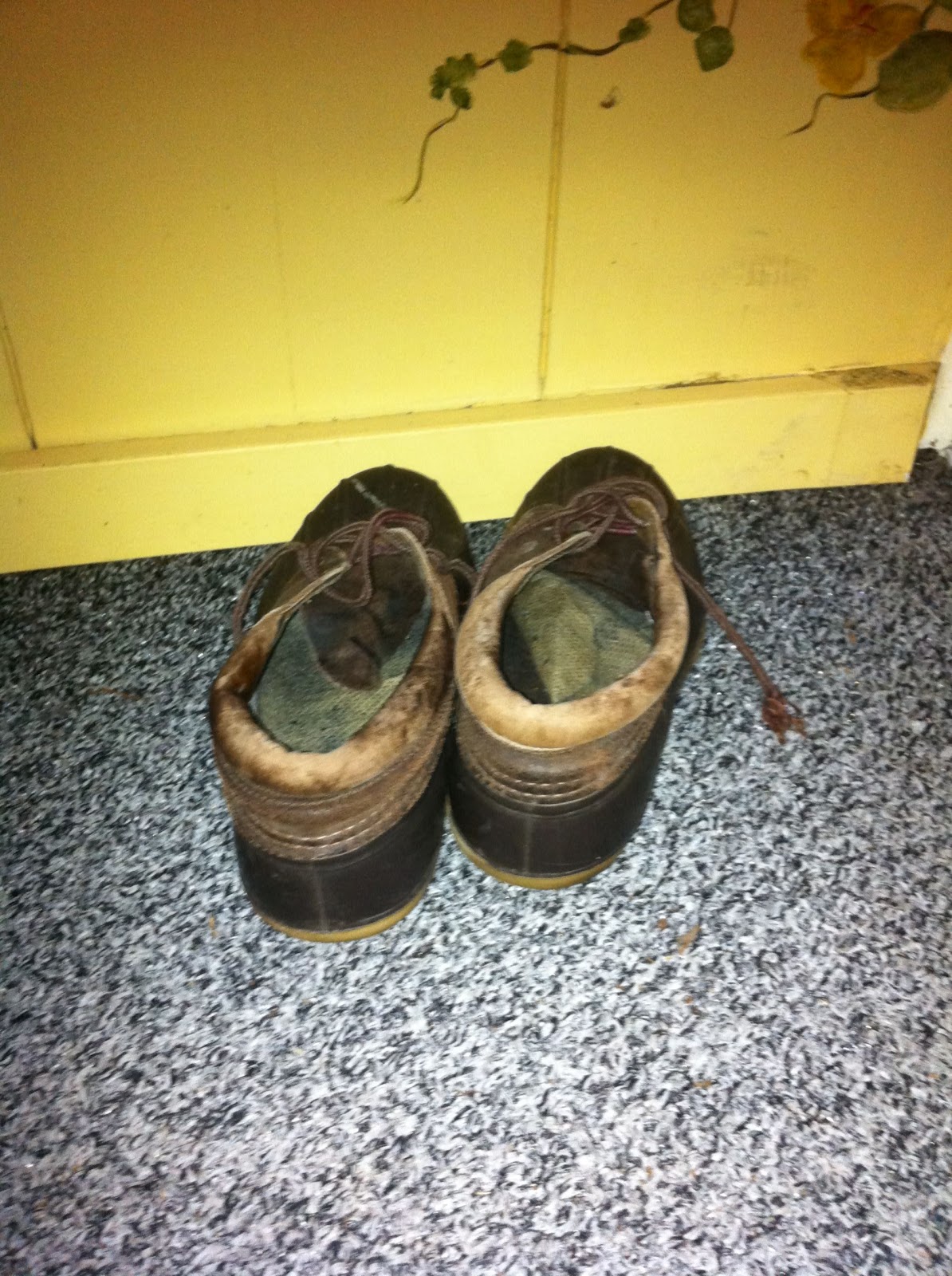
Then there are my "cycling shoes" (some tired rubber moccasins) for when it gets really wet--which is isn't all that often, really. 

The kind gift of a bicycle pump has proven helpful, and I have some flashing lights for the front, the back, and spokes (in addition to the dynamo-driven ones that came with the bike), mostly with rechargeable batteries--these lights help with distracted drivers, too. 

I splurged and got a cup-holder for the occasional mid-ride coffee and as part of a future umbrella carrier setup. A couple bungee cords prove useful occasionally. 

That pretty well covers it.

Other than the panniers and the coat, everything but the bike was quite affordable or something I already had. It doesn't have to be hard, complicated, or expensive. I know one person who used old plastic laundry soap bins with handles as the basis for some very effective, rugged, and cool DIY panniers. He just added some bolt-on hooks to them, a few reflective stickers...and bingo: cargo-carrying capacity. Like many in in the daily cycling world, he just keeps his eyes on the prize of it all: affordable, effective transportation.


Tuesday, February 7, 2012

Going Upright: The good and not so good

For many years I rode a 1960's Raleigh Sports (dubbed "Walter") on an occasional basis. I had tried a drop-handlebar 10 speed (Peugeot... ah, youth), but had never liked it as much as Walter's more upright style. However, the Raleigh had one major drawback: its brakes were practically non-existent in the rain. This was a big problem in the Pacific Northwest. When it wasn't raining, the front brake--no matter what I tried--set up a vibration that caused the fender to make an amazing shriek. I kid you not.


Well, I lived with all of this because Walter had relatively wide tires, three speeds that pretty well covered the needed range, good mudguards, a well-worn Brooks saddle, and lots of little personalized touches. The bike was so well-worn that no one was interested in stealing it. It served me well, especially when I was living in a very flat, small town. 


But those brakes....


There came a time when a number of repairs needed to be made, some key parts were wearing out, and I really wanted better braking in all weather (and at least some in the rain). Then I was introduced to Dutch bikes. Suddenly, I found the bike I had always really wanted: very, very upright, very solid, and with excellent brakes. It came with a full gear case, superb heavy-weather capability, and a very nice rack. While costly, I decided that it would likely be the last bike I would purchase, since the previous one had lasted me nearly thirty years.


I cannot begin to tell readers just what a pleasure this bike has been. Being this upright means being much more aware of traffic around me. The design and construction materials mean a very solid, smooth ride. This takes the cake when it comes to an in-town, dependable transportation tool. 


Upright bikes have a specific purpose at which they excel: basic transportation. They have their limitations, too. The main one is wind. If one is bolt upright and there is any wind opposing the bike, you feel it. This can be quite debilitating on a gusty day. Another matter is weight: Dutch bikes tend to be heavy. They do not take off from a stop quickly, and they never get "fast." Then, there can be the issue of turning and "cockpit" room. If, as on mine, your Dutch bike's handlebars reach far back toward the saddle, one has to get used to making sharp turns with a considerable lean--or by moving one's leg out of the way at a slower speed. Hills are another issue: this bike's weight and geometry make it very difficult to go up steep hills, even with an expensive/extensive set of gears. It is nearly impossible to "pump" the pedals while standing. Since most Dutch bike riders go about town in their regular clothes, there are many times when I just walk it up, rather than get wringing wet trying to tough it out uphill.


But the general utility, stability, and durability of these bikes wins out in my experience. This bike (with the right racks and panniers) can perform many functions of a car, and lead to a variety of added benefits.  Going upright has been a joy, and saved me quite a bit in gas money. This bike also allows me to drink coffee while riding pretty darn safely. That is worth something...


I still have Walter... I can't quite give him up. I trot him out in the summer, for some rides in parks and the like. But Gabriel (my Dutch bike), has proven to be the type of bike I was searching for long ago, but didn't know how to find. I hope others will find the bike allowing them to go "multi-modal" and experience more of the world from two wheels in coming years.