Friday, June 3, 2016

Signs of the Times

I have a penchant for taking pictures of signs…especially strange or ironic ones. I’ve done this for years and derive a kind of mild pleasure reviewing them from time to time. The small follies of human attempt to govern, inform, or control provide a gentle reminder of how fragile our grip on things really is.

So, here are some pictures (mostly in Salem) I have taken of signs that stuck out…

#1: Morning Glory, the Forbidden Horse


When we moved back to Salem some years back, we discovered what is surely one of the odder signs in town while walking around Waterfront Park. This sculpture, placed just outside the Carousel building, appears (at first glance) to be an open invitation to children (and others) for a photo-op. But, no! Even though cushioned rubber matting has been thoughtfully applied beneath it (perhaps at the suggestion of a nervous city lawyer or risk manager?), this horse is most definitely off limits to passengers. As the sign observes, this is not a piece of play equipment. No, siree. If the saddle’s patina is worn to a luminous polish from the many folks who didn’t read the sign, that’s not the fault of the City. Nope.

#2: Just What Sort of Business?


This sign is just off the Church Street Bridge over Shelton Ditch/Pringle Creek, down in a grove of trees by the creek side. There must have been a perfectly logical reason for this sign (perhaps someone could illuminate me?), but having this sign in such a setting begs the questions: “What business?” and “What hours?” It also suggests (at least to me) that trespassing during business hours is just fine...

#3: Face Off


Schools like South Salem High have many parking headaches, but this sign suggests a persistent problem with something I had never before considered…

#4: Ignored


This sign’s command, silently thundered day and night, is constantly ignored by the tenants.

#5: Be Kind to Your Amphibious Friends


While riding in Corvallis, Oregon a few years back, I came upon this thoughtful warning about an apparently common problem there. I will tell you that no newts were injured to make this blog post.

#6: Before and After


These two photos show a change of mind about how to treat the bike lane on one of Salem’s more bike-trafficked roads (Winter Street) during the Hospital’s long stretch of construction a while back. The first picture shows the once-common view that “something has happened to your bike lane, so deal with it.” The latter suggests that bikes and autos both have a place on the road and caution for everyone would be a good idea. This is one place where cyclists in town should express appreciation…and keep up the pressure.

#7: How Quaint


For many years, when St. Paul’s Episcopal Church had its rummage sales this sign was placed on an oak tree near High Street. It looks to date back to the gracious, spacious time when “today” was still hyphenated (at least by the well-heeled) as “to-day.” The reverse of the sign shows the admirable quality of consistency in its spelling of “to-morrow.” I haven’t seen this sign out recently and hope it has not been trashed, as it harkens to a less anxious era…something I find comforting just now.

#8: By Any Other Name…


I took this picture whilst in York, England. In Salem, we call it the “Center 50+,” making it seem oh so sexy and active. But in York, there is a kind of English sobriety and dignity about the facility I find a lot more attractive. I also like the dedication to St. Sampson...something distinctly uncommon on this side of the Pond.

#9: Salem’s Own


Of course, how could I omit Salem’s greatest sign? I even know one of the people whose experience of “interaction” with Owl Capone gave rise to this graphic. I still think people should try wearing a helmet while passing through Bush Park in the spring…perhaps some could be hung on pegs under each sign?

#10: A Sign for the Times


This inscription on the north face of the State Capitol building is extremely appropriate for the current election cycle. The irony that it was inscribed on a building in a time and place that had a very, very uneven record of living up to its ideals in no way mitigates the fundamental import of what it says to every era and nation.

#11: A Reminder of the Dangers of Literalism


This is the sign that made me think about writing this post. I saw it while out today. It suggests either expedience or a singular lack of insight. In any event, it was momentarily entertaining.

#13: A Tale of Two Bumper Stickers

 
Our family likes Salem a great deal, but some gentle ribbing is good for people and organizations. Many people are familiar with the “Keep Portland Weird” mantra, but an enterprising fellow in town had some “Keep Salem Lame” bumper stickers printed up a few years back, and my wife and I sought high and low how to get one. On a morning walk happened upon the creator of this gem, and he proved willing to part with one—if we promised to put it on our car.


Some time later while in Portland we parked just behind a car with the famous Portland Credo and we decided to take a picture of both sentiments. 

Far from denigrating Salem, our purpose in sporting this bumper sticker is quite genuine: we are happy to keep Salem different from Portland (a place with an increasing number of unsavory problems in spite of all the hopelessly goofy press); if that makes us “lame,” so be it. We’ll take some lameness over much of the weirdness, thank you very much. Diversity is good, right?

Saturday, April 30, 2016

Unfinished Escher Staircase Found in Salem, Oregon

Today the art world was staggered by news of the discovery in Salem, Oregon of a work of art thought lost, but actually only misplaced. We speak here of M.C. Escher’s unfinished and unique sculptural project: “Stair Steps to Their Beginning.”

This work, commissioned by the then-influential “City of Salem Guild of Avant-Guard Citizenry” (CoSGoA-GC), and located just south of the Salem Public Library’s main branch (part of the 1972 Salem Civic Center), was to be the culmination of Escher’s long line of mischievous images, inscrutably combining surrealist visionary symbolism with an ode to American Local Government Bureaucracy.


Escher, who accepted the commission with great trepidation and would only agree to it when three barrels of pickled herring were made part of the fee, had never before attempted sculpture in any medium. Being nearly two-dimensional himself, he had kept to illustration in his previous works. But, nearing the end of his life and sensing that, as he liked to say: “Vat do zose Salemites know about Platonic solids und Möbius strips, anyvay?!” he took his final artistic gamble.

The commission itself asked only for “an aesthetically-pleasing means of approach to the Senator Wayne Morse De-accession Bin” using “concrete, brick, or Salem’s traditional building material—compressed cherry pits.” This allowed Escher, a notoriously fastidious and economical man, a great deal of latitude.

The budget, considered exorbitant at the time, was $326.13, with $1.50 being donated by the Greater Salem Arts Foundation, $3.57 from the “Memories of Happy Days at Brush College School Club," and a surprising donation of $22.12 from the Crabtree & Scio Retired Air-raid Warden Association. The remainder was given by CoSGoA-GC from its usual source: a share of the massive annual haul from overdue-book fines. This use of library fine funds for public art ended up causing legal wrangling between the CoSGoA-GC and the once-powerful “Guardians of the Public Purse & Dining Society” (or the GPP&DS, usually just referred to as The Salem Grouch Club) that only settled out of court last year.


The plans for the sculpture were drawn up on Escher’s favorite surface of tanned rhino hide (“because it stands up well to humidity and grease-stains from cheese,” the artist maintained) and sent via the Holland-America Line’s SS Statendam to New York City, where they were mistakenly impounded as contraband. After a diplomatic row requiring then-National Security Advisor Henry Kissinger’s personal intervention, the plans were released for transport to Oregon.


Construction was complicated by the fact that Escher had made the measurements in cubits rather than the usual feet or meters. Because several different foremen were involved in the execution of the sculpture, and because the foremen’s forearms were not all of the same length, certain irregularities crept into the project—irregularities which speedily led to Escher’s renunciation of the enterprise, his demand for the plans back, and the ultimate termination of construction before completion. The nearby concrete brutalism library building opened on schedule, but the half-completed stairway meant to intrigue people selecting de-accessioned copies of such classics as A Practical Guide to Surviving Nuclear War was gradually forgotten even while it remained in plain view. Sometime in the late 1970s, the Senator Wayne Morse [Memorial] Bin was moved elsewhere and weeds took over the ill-fated spot, aiding its slide (or, perhaps more appropriately, its descent) into obloquy.

In the 1980s an enterprising hot-dog vendor opened a stand at the top of the stairs for a couple seasons, and Vice-President Dan Quayle made his only speech in Salem (during a largely forgotten tour) late one February night from this location. Aside from that, nothing is known about the “dark years” of the Escher Staircase.

Then, two weeks ago, city employee Zelma Flores happened to stumble over the staircase’s lowest step while making her way to the parking structure. Enquiring with library staff about “that big hunk of concrete” and why it was there, she was met with vacant expressions. No one could remember seeing the stairs before! Lost in plain sight, Civic officials had to be taken by hand from their Doge-like isolation in the City Council Chambers to the site of the hidden gem in their midst. Confronting Escher’s partly-completed masterwork, their response was to appoint an outside consultant to study the stairway for possible sale to help fund a proposed third bridge across the Willamette River.


Curiously, Escher himself never visited Salem, but did keep a postcard of the city (actually of Salem, Massachusetts) stuck in his dresser mirror at the Rosa Spier Huis in Laren, Netherlands until his death. The night after his demise, the postcard mysteriously disappeared and then just as mysteriously re-appeared years later in a book on the Salem (Oregon) Public Library shelves. That book was: Years of Upheaval, by Henry Kissinger, last checked out to the author. 

The postcard marked a page with these words underlined in lavender ink: “An event that year, involving the hide of a rhinoceros, made clear I must advocate for the opening of China to the West.” Thus, Salem’s too-little-too-late remnant of a milestone (rather than millstone) in art history contributed to the current the World Order.

Friday, April 15, 2016

Back to life & a new series on bike stands...

In case anyone is actually interested, this post is meant to formally "reactivate" this blog.

Some months ago I was diagnosed with cancer. Many things changed suddenly and dramatically. My focus went to addressing the illness and my life. Blogs (I write for two of them) took a back seat (or, more accurately, a trailer well behind the back seat). 

I am grateful that the cancer was detected while it could be treated surgically (it was of a type that tends to be lethal once its gets away from stage I). I am also grateful that I am pretty much back to my usual level of energy and stamina; however, cancer does really change one's life. In my case, it may well have been for the better. Greater appreciation, intentionality, focus, gratitude, humility, and recognition of the preciousness of even the smallest gift...these are all fruits of an unwished-for-but-not-without-blessings experience. I can also say that the folks who work at the Salem Hospital Oncology unit are amongst the best in the business. My trips to the hospital on pastoral work now usually include a visit to that floor to remember and say "thank you" to anyone I meet there who served me then. 

One other thing: if you have symptoms of a serious change in your body...get to the doctor (or, as in my case, the ER, which proved to be the better choice). Delay can be costly.

But, this is not really a cancer recovery blog, so I'll just leave it at that. I'm glad to be back, writing occasionally on biking issues in Salem...for anyone who still is interested in reading.

*  *  *


With the change in weather these last weeks I have been out on my bike more, soaking up the sun and enjoying the many blooming trees. I've had some seasonal maintenance to do on my bike (mostly tightening up things that tend to get loose), and I have noticed even more folks out there in Salem biking from place to place on what I would call honest-to-goodness commuter or utility bikes. That is good to see.

My trips from place to place occasionally take me to new stops and the bicycle infrastructure provided there. That brings up the other subject of this post: bicycle parking stands.

As the season progresses, I plan to take pictures of a number of different types of bike stands in town (there are a surprising variety of them) and then discuss each. This is the sort of heavy-hitting investigative journalism I prefer. So, fasten your seatbelt for controversy ahead; I'm taking no prisoners and sparing no reputations...especially my own.

#1: The Yellow Postal Special - A Classic Bike Stand

When a person pedals to Pringle Park Plaza for postal purposes (wow...a lot of alliteration there), this is the bike stand that awaits you. It is perhaps the most classic design in America from the pre-security days. This is truly a "stand." Its purpose is to keep the bike standing up while you are in the Post Office running your errand. 

Such stands were de rigueur when I was a child; they were ubiquitous at schools, post offices, and grocery stores (where they had any). They harken to a time when theft was much less likely, or when a simple long padlock was considered suitable protection (I well remember one such lock my mother had for her one-speed back-pedal brake Sears special). In those days bikes were rarely so expensive or exotic as to motivate anyone to go to the effort of cutting the shank of a lock. The lack of quick release anything made such theft a bit more difficult, as well. I remember putting my Schwinn Typhoon in many such stands years ago and thinking nothing of it.

Gradually, however, I heard about more bike theft and decided to purchase a chain lock (covered in groovy translucent blue plastic) to discourage joy-riders. Such stands as this worked OK with such locks.

These reminders of halcyon days gone by (imagined or real) are no longer very good for security purposes; the u-lock I normally employ really doesn't work with this sort of stand, forcing me to use the cable lock I still carry. However, such stands do accommodate a large number of bikes for their size--and they really do work well to stand a bike up by its wheel (front or back), something the now-ubiquitous Bike Staple doesn't do as well. Ah, the give and take of life....

Bike stands like this are an inexpensive way to provide for the needs of cyclists. If, like me, you have a bike that is probably not high on the list of types ripe for theft, such a stand can still be made to work. This kind of stand is, however, generally only seen on the grounds of older public buildings today--a testimony to the design's durability, changing times, and the place of bike infrastructure in the priority list of civic life. I'm not really complaining...just noticing. I'm also just glad I don't have a bike that says "steal me" when faced with this "honors system" sort of stand.

Wednesday, May 6, 2015

Putting a Price Tag on Everything

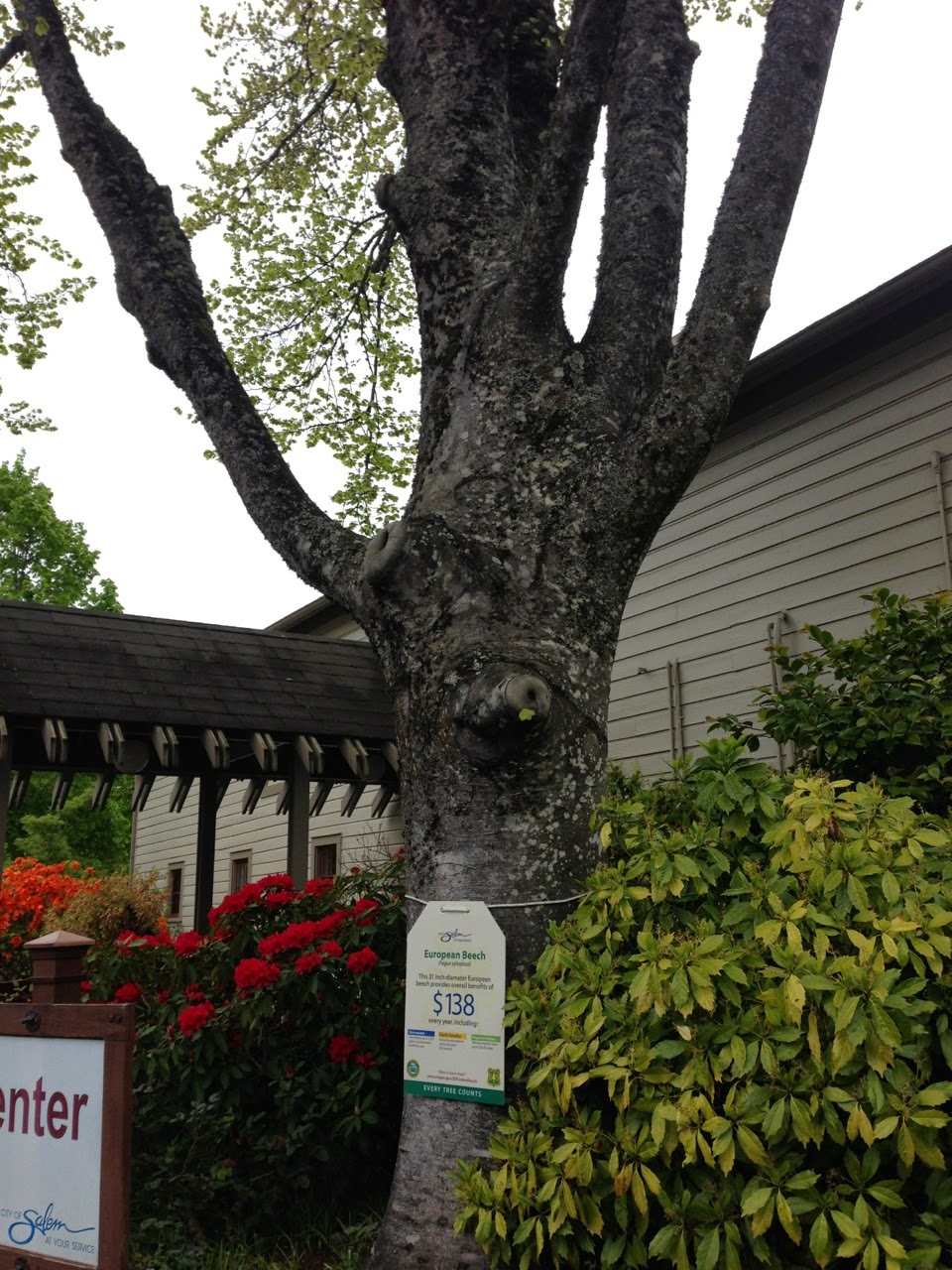
I was recently cycling from church back home through Bush Park. Going along slowly as I do, there a plenty of opportunities to see interesting things along the way. As I started to pass by the Bush Barn Art Center, I came upon this scene:


In an effort to put a monetary value on a tree, a large price-tag was tied around the trunk, complete with explanatory text. It was all very nicely done and made its point quite effectively.


The project has obvious merits and I cannot fault any of the specifics. I later followed the suggested web link to a nice web site that had all sorts of information about trees and their impact on urban environments. Yet, somehow, I felt a surge of frustration in reading it. Perhaps it was that dollar sign on the tag.

Over the years, the need to justify everything in terms of monetary value has become intense. There is hardly a single moment in life that we cannot somehow trace back to a cost or a pecuniary benefit. Being "monetized" is our way of life now. We have become "made of money," as my mother used to say about some avaricious people.

The "Every Tree Counts" campaign is simply trying to speak to us in our own language I suppose; but, what an impoverished language that is, bespeaking an impoverished spirit.

In general, I very much like trees. The sound of wind through tree branches, or the cool air under a spreading oak on a hot summer day delight me. The way an old tree has absorbed the eras during which it has lived, or quietly presided over years of change intrigues me. The effect of lots of warm wood in a home or church building or other interior connects me with earth and sky and seasons. I grew up in this part of the nation; trees and wood are part of what defines life and landscape.

There are times when trees must be cut down, and there are times when trees should be saved. Economic factors, of course, play into these decisions. (though it does seem that the calculations can be "adjusted" in fairly creative ways to get desired results). I am not a "tree-hugger" in the romantic sense, nor am I a "mow 'em down" pro-development zealot. I prefer to look at the whole, trying to bring about and preserve a certain balance in the lived environment between change and continuity. The trick is in how to make judgments.

The problem with the approach to understanding trees (or other things) taken in this instance is that it is a furtherance of the old story in America: Creation has meaning to the extent that we can measure and put a money value on it. 

I think about this sign and then I think about my time at an Indian Reservation and talking with members of the tribal community there about their relationship to nature. A discussion got going about the recent stealing of some huckleberry plants from native lands by non-Indians. In addition to the fact that crimes of trespass and theft had occurred, a much more serious matter was brought up: the huckleberry plants form a "tribe," just as "alive" and valid as the human population. Together with the salmon, the rocks, the forests, the deer, and all the other "nations" which shared the Creation with the resident tribes, the "huckleberry tribe" had a sacredness that needed to be honored, not ripped willy-nilly from the earth for monetary gain. In this logic, if it can happen to huckleberries, why not people? American Indians know that story all too well.

I found much the same thing in Ireland, where freeway expansion plans often were at odds with sacred groves of trees. Frustrating to modernity and efficiency, yes; but a counter to the view that the ends justify the means at all costs, especially those without a dollar sign attached to them.

Now, I am not suggesting we all adopt an indigenous viewpoint on trees, rocks, or nature. Instead, I am advocating an alternate, or perhaps and additional approach to the discussion--one that will prove both more equitable and more inspirational over time.  I think it both a kind of spiritual and intellectual poverty to teach and practice a way of life where monetary value is the final, highest, and essentially only way to "value" something.

I think we should begin by viewing a tree not as the sum of its financial benefits or its utility or inconvenience to us but as a presence, a part of the whole that has benefits far beyond what can be measured in terms of gallons, pounds, or dollars. These tools for measurement have their place, and I am not against their use; but only in conjunction with other ways of valuing, other approaches to meaning. A "both-and" approach would be ideal.

Perhaps, in addition to the monetary and scientistic information provided on the tag, a passage from an appropriate poem or lyric should be provided--just something to say that this tree is more than a price or a tool for our benefit. As it stands, this campaign seems to me to reinforce a rather sinister aspect of our cultural inheritance: that of extractive self-justification.

Whenever we look at the Creation primarily through the lens of what it does for us, we are essentially following in the footsteps of the extractive colonists who came before us...and who left such a legacy of destruction and spiritual impoverishment behind them. We are liable to repeat their folly in unintended ways because we are still using their thinking, albeit in a different manner.

So, while I am hardly up in arms about this little reminder of our cultural impoverishment, I do feel it is worth taking up a "minority report" about its assumptions and aspirations. I would suggest that it what is needed is a dose of people like John Muir or Wendell Berry, in addition to (and really above) all the numerical arguments. Only a deeper reason for trees, streams, meadows, ecosystems, and ultimately people, will stand up to the ever-shifting and greedy rationales of those who play with numbers to justify their goals.

Otherwise, someday we are each going to be required to don such tags ourselves. I just hope my tag--and yours--will indicate we are enough of a benefit to keep around.

Saturday, March 21, 2015

So: Which is It?

There are a lot of times in life when we are legitimately confused. I’m not talking about the times when we are willfully confused (being exasperated with ludicrous bureaucracy) or tactically confused (casually “forgetting” when it suits), or even confused for the sake of saving someone else’s feelings (there is a fine art to this in clergy life). No, I’m speaking of the genuine confused article.

The occasion for this post comes from two signs on Church Street as one heads north, each purporting to herald the start of the pedestrian-only sidewalk safety area downtown.

The first sign is at Trade Street, in front of a block of sidewalk that gets relatively little pedestrian traffic.


The second sign is at Ferry Street, at the start of a much busier block next to the historic Methodist church, and a more logical place, overall.


The question is: which is it? Are both signs needed? Does the zone start on Trade or Ferry on the east side of the block?

Now, I have an ulterior motive here. When travelling south along Winter Street after leaving the Capitol grounds, I often take a right on the vestigial, old part of Ferry and travel a couple of blocks west towards the intersection of Church and Ferry (one of the many major speedway intersections in this part of town, slicing everything into odd-shaped sections so that motorists can travel at high rates of speed—except when they can’t, which is fairly often). I then cross the Mario Andretti Memorial Speedway there and head south on Church (on the sidewalk) to Trade, where I cross the eastbound part of this Military-Industrial Road Complex in order to get to the quiet part of Church Street and resume my travel south toward Bush Park on the street itself.

Now, in order to do this, I need to travel on the sidewalk that one block between these two signs (because it is a one-way street going north). If I am riding my bike to do this, I am apparently violating the law—something I’m not keen on doing.

I bring this all up for a wider reason, as well. Salem is a bit of a crazy quilt for transportation cyclists who, like myself, prefer quiet streets rather than risking life and limb on the big speedways rammed through the fabric of our fair city. Getting from one place to another is frequently hampered by these asphalt-and-concrete barriers. Since they are normally of the one-way or divided highway type, these roads present difficulties for cyclists making our way across town. There are usually alternatives, but they tend to be much more circuitous, risky, or actually more likely to put one in conflict with a pedestrian than the block I’m bringing up (this is the case in the area I mention, as the logical alternative is to take the pedestrian path and underpasses from Church over to the Willamette campus…but that really does put one in contact with a lot of pedestrians and several blind corners).

Church Street south of downtown is a natural bike route to Bush Park. It is a good place to cross Mission Street (a better-than-average crosswalk with an island and at a point where that infamous thoroughfare is at its narrowest), and there is a path up the hill to the park’s interior (though it would much better if the old carriageway were restored as a multi-user path…another of my hobby-horses).

Yet, once one gets to Trade and points north, Church turns into quite another critter, much less friendly to cyclists (of the normal sort). Getting from Church to Winter is generally advisable, allowing one to use the Capitol grounds to head north or to connect to points east. This, too, has its own challenges, but is much less anxiety-producing than continuing north on Church. It is that connection from Church to Winter that makes the confusion about whether the block in question is (or is not) in the Pedestrian Safety Area.

When I am walking downtown, I really don’t like having to dodge cyclists on the sidewalk. So, I am cognizant that me being on the sidewalk anywhere in that area is not optimal. However, the maze of cycle-unfriendly possibilities makes it unclear what the best way to get from downtown to Bush Park is.

Winter Street is generally the best bet, except for the rather dreadful intersection with Bellevue—the traffic signals there do not seem to be actuated by cyclists, meaning that one either waits for a car to make the light change, or one has to dismount and push the pedestrian crossing button. If this were to change, it would make Winter the clear first choice (except for the endless construction at the hospital). The lights at Winter and Mission now seem to respond to cyclists, and that leaves the Bellevue signal the big problem.


Well, that’s a lot of verbiage to ask: “Which sign is telling the truth?” I hope someone can tell me. Until then, I’ll ponder the possible hidden meanings of it all.